Answer Engine Optimization (AEO) for Promo Distributors: How to Show Up When Potential Clients Ask AI.
Subscribe to the Growth Lab
Real strategies and insights for promo distributors who are serious about growing their business. Backed by over 20 years of industry experience.
Key Findings
- 73% of B2B buyers now use AI tools like ChatGPT and Perplexity during their vendor research process and 37% consult AI before they even open Google.
- AI-referred traffic converts at 5x the rate of traditional Google organic traffic. Buyers who find you through an AI recommendation arrive with higher intent and a clearer sense of what they need.
- Only 5 brands typically capture 80% of AI-generated responses in any given B2B category. You’re either in the answer or you’re invisible.
- 61% of the B2B buying journey completes before a buyer contacts a salesperson. AI tools are accelerating that by delivering synthesized comparisons instantly.
- Gartner projected a 25% drop in traditional search volume by 2026 as buyers shift to AI chatbots and the promo industry is largely unprepared.
- The distributors who build AEO authority now will compound that advantage over time. The ones who wait will spend years and real money trying to close the gap.
Table of Contents
- How are clients finding you now?
- Has buyer behavior already shifted and what does the data say?
- What is AEO, and why is it different from SEO?
- How does AI decide who to recommend?
- Is there an AEO Playbook for promo distributors?
- Test it right now: What does AI say about you?
- How much time do promo distributors have to act on AEO?
- AEO Quick-Start Checklist: What Should Promo Distributors Do in the First 30 Days?
- Where are the Growth Opportunities Within your Promo Business?
How are clients finding you now?
Quick Answer
Largely through AI tools. Marketing managers, procurement teams, and HR directors are opening ChatGPT, Claude, Gemini, and Perplexity and asking for vendor recommendations by name and the AI delivers a short list of companies with reasons to contact each one. If your distributorship isn’t in that answer, you don’t exist to that buyer.
Something has changed in how your clients find you.
For years, the playbook was simple: rank on Google, show up at trade shows, and get referrals. Those channels still matter. But a new one has quietly emerged that most promo distributors aren’t thinking about yet.
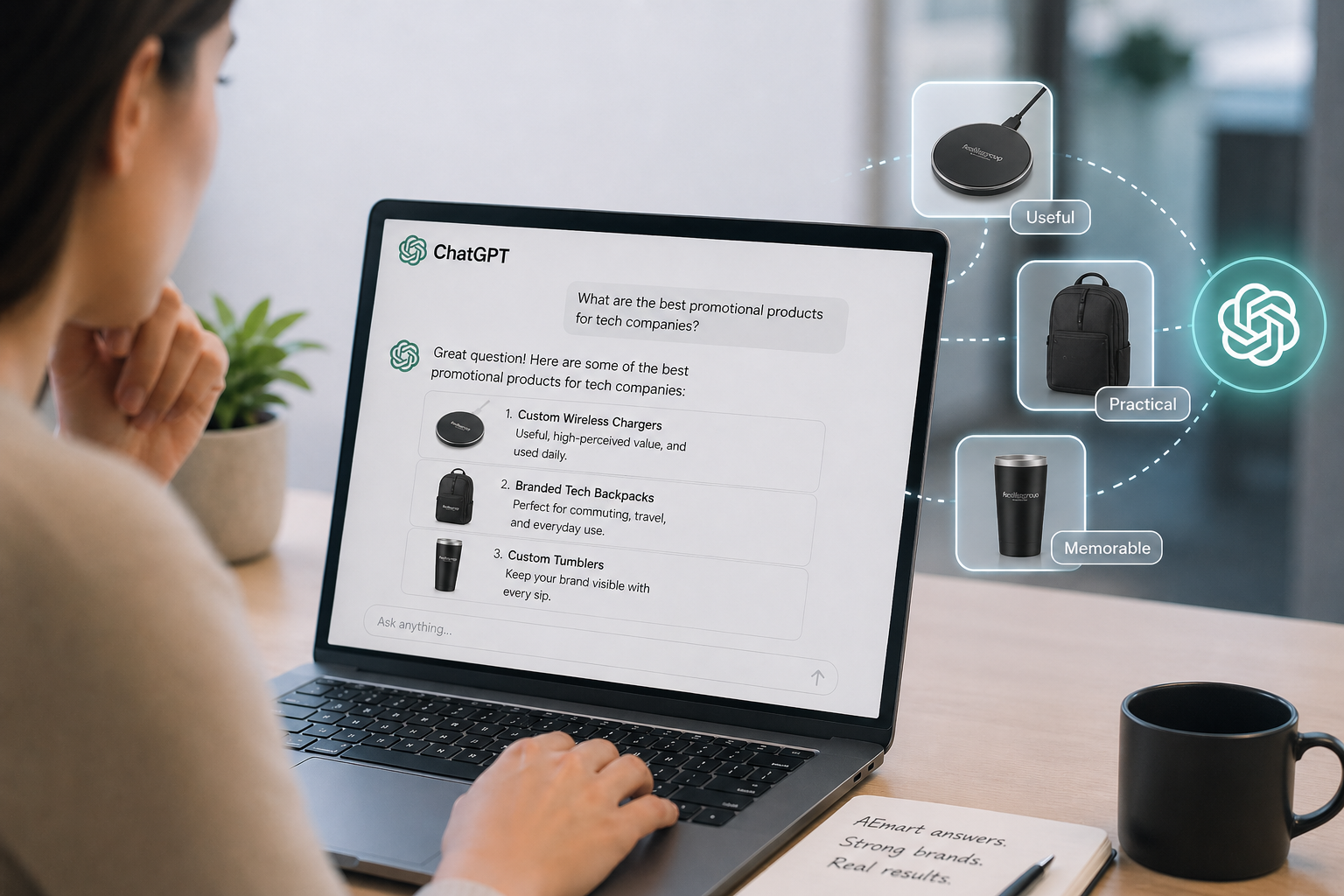
Right now, marketing managers, procurement teams, and HR directors are opening ChatGPT, Claude, Gemini, and Perplexity and typing prompts like the following:
- “Recommend a promotional products distributor near Dallas that specializes in corporate gifting.”
- “What are the best promo companies for a 500-person tech company that needs branded merch for onboarding?”
- “Find me a promotional product distributor that can handle custom apparel for a national event.”
And the AI tool gives them an answer. Not a list of ten blue links to scroll through. A direct recommendation, often with three to five company names, a brief explanation of each, and a reason to reach out.
If your business isn’t in that answer, you don’t exist to that buyer.
This is Answer Engine Optimization (AEO), and it represents one of the most significant shifts in how B2B buyers discover vendors since Google Search itself.
Has buyer behavior already shifted, and what does the data say?
Quick Answer
Yes, and the numbers back it up. 73% of B2B buyers now use AI tools during their research process, and 37% consult AI before they ever open Google. For promo distributors, that means a growing share of potential clients are finding (or not finding) you through AI recommendations, not search results.
This isn’t a prediction about some far-off future. Buyer behavior has already changed.
A 2026 analysis of 680 million AI citations found that 73% of B2B buyers now use AI tools like ChatGPT and Perplexity during their research process. A separate study found that 37% of B2B buyers consult AI before they even open Google.
The implications for promo distributors are enormous. Consider this:
- Two-thirds of B2B buyers say they now use AI tools as much as or more than traditional search engines for finding new vendors.
- 61% of the B2B buying journey completes before the buyer ever contacts a salesperson. AI tools are accelerating that by providing synthesized comparisons that used to require visiting dozens of websites.
- AI search traffic converts at 5x the rate of traditional Google organic traffic. People who find you through an AI recommendation arrive with higher intent and more context about what they need.
- Only 5 brands typically capture 80% of the top AI-generated responses in any given B2B category. The concentration effect is extreme. You’re either in the answer or you’re invisible.
Gartner projected that traditional search volume will drop 25% by 2026 as users shift to AI chatbots. The promo industry, which has historically been slow to adopt digital marketing trends, is sitting on a narrow window of opportunity. The distributors who optimize now will lock in an advantage that compounds over time.
What is AEO, and why is it different from SEO?
Quick Answer
SEO (Search Engine Optimization) gets your website ranked on Google. AEO gets your business recommended by AI. Google presents a list of links and lets the buyer decide. AI answer engines pick a handful of names, explain why each is worth contacting, and deliver that directly. AEO is about being one of the few companies an AI trusts enough to recommend, not one of many options on a page.
SEO helps your website rank higher on Google. AEO helps your business get recommended when someone asks an LLM a question.
The distinction matters because the mechanics are fundamentally different.
Google gives users a list of links and lets them decide. AI answer engines synthesize information from multiple sources and deliver a direct recommendation. They don’t send the user to ten websites to compare. They do the comparison themselves and present a curated answer.
What this means: SEO was about being one of many options on a results page. AEO is about being one of the few names the AI trusts enough to recommend.
| Traditional SEO | Answer Engine Optimization | |
|---|---|---|
| What it does | Ranks your website on Google | Gets your brand recommended by AI |
| User experience | List of links to browse | Direct answer with named companies |
| How you win | Keywords, backlinks, page speed | Authority, consistency, structured content |
| Competitive dynamic | Page 1 vs page 2 | Named in the answer vs invisible |
| Conversion behavior | 2-3% conversion rate | 12-17% conversion rate |
The good news: AEO and SEO are complementary, not competing. The foundational work you do for AEO (clear content, structured data, authoritative information) also improves your Google rankings. But AEO requires an additional layer of optimization that most promo distributors haven’t considered.
How does AI decide who to recommend?
Quick Answer
AI systems don’t have a favorites list, they evaluate trustworthiness based on four signals: consistency across multiple sources, clear and structured content, E-E-A-T authority indicators, and content freshness. Businesses that show up reliably across the web, describe themselves clearly, and earn third-party mentions are the ones that get surfaced.
Before diving into tactics, it helps to understand how these AI systems decide which businesses to mention. AI answer engines don’t have a favorites list. They synthesize information from across the web and surface the sources they consider most trustworthy and relevant.
There are four primary signals AI models use to evaluate whether your business belongs in an answer:
1. Consensus across multiple sources
If your business is mentioned consistently across multiple independent sources such as your website, directory listings, industry articles, client testimonials, PPAI profiles, and social media, the AI treats that as a trust signal. Conflicting or incomplete information across sources reduces your chances of appearing.
2. Structured, Clear Content
AI models parse content differently from humans. They look for clear definitions, direct answers to specific questions, and well-organized information. A page that says, “We are a full-service promotional products distributor based in Chicago, specializing in corporate gifting, branded apparel, and trade show merchandise for mid-market companies” gives the AI exactly what it needs. A page that says “We deliver creative solutions that drive brand impact” gives AI nothing to work with.
3. Authority and E-E-A-T Signals
E-E-A-T stands for Experience, Expertise, Authoritativeness, and Trustworthiness. It’s the framework that Google uses and that AI models have adopted. For a promo distributor, this means published case studies, named authors on your blog posts, client reviews on third-party platforms, industry association memberships, and mentions in industry publications like PPAI Media.
4. Freshness and Specificity
AI systems prefer content that is current and specific over content that is generic and stale. A blog post titled “5 Trending Promo Products for Healthcare Events in 2026” is far more citable than a static services page that hasn’t been updated in three years.
Is there an AEO Playbook for promo distributors?
Quick Answer
Yes, and it consists of six core actions: rewriting your website for AI readability, building a Q&A content strategy, claiming and optimizing every directory listing, earning third-party mentions and citations, implementing schema markup, and publishing fresh content consistently. None of this requires a big budget. It requires clarity, consistency, and follow-through.
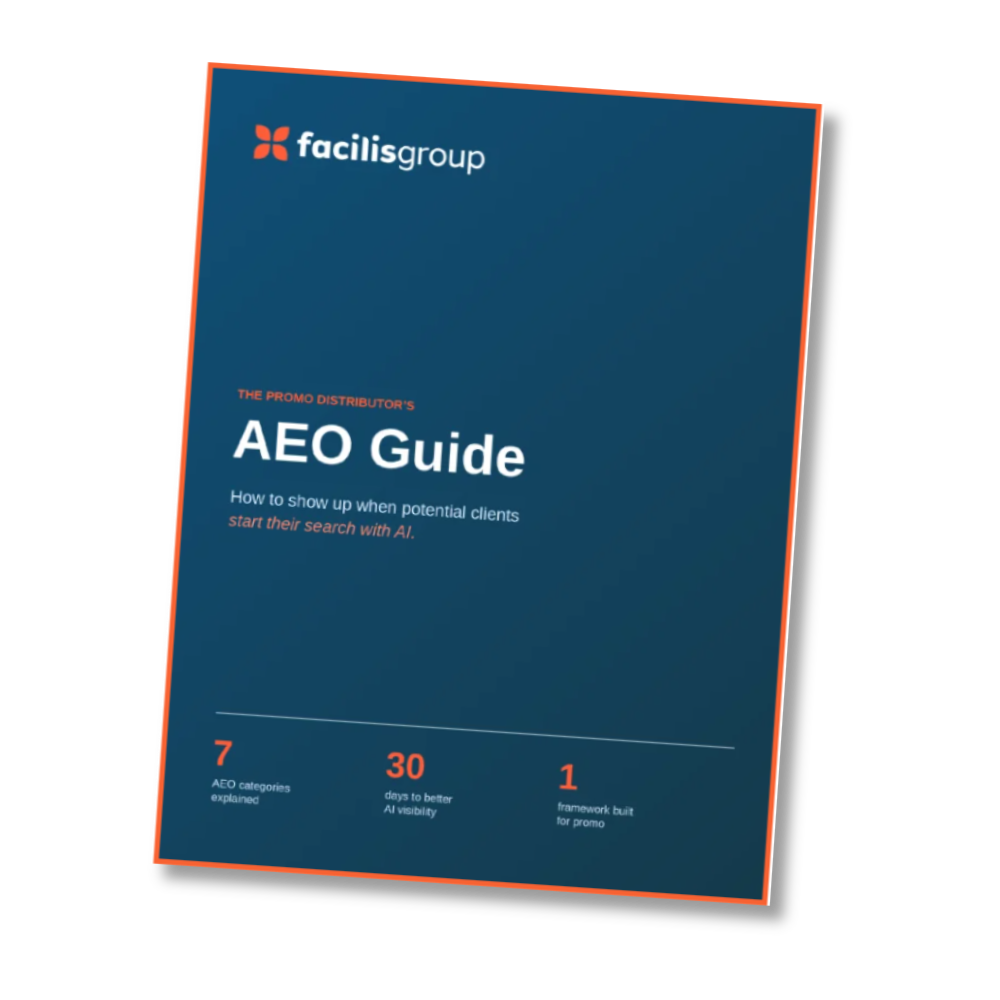
We built the Promo Distributor’s AEO Guide which is a step-by-step check list of the exact action’s promo distributors need to take to optimize their digital presence and show up when potential clients are using AI tools to find them.
These are the specific actions you can take to increase your chances of showing up in AI-generated answers when potential clients are looking for a promo distributor.
Step 1: Rewrite your Homepage and Services Pages for AI Readability
Most promo distributor websites are designed to impress humans with big visuals and vague taglines. AI models need something different: clear, factual, definitional content that answers the question “What does this company do, where, and for whom?”
What to do:
- Open your homepage and service pages with a clear definitional sentence. Example: “[Company Name] is a promotional products distributor headquartered in [City, State] serving [industries/verticals] with [key capabilities].”
- List your specific capabilities: custom apparel, branded merchandise, trade show kits, corporate gifting, kitting and fulfillment, and e-commerce company stores.
- Name the industries you serve. “Healthcare, education, technology, financial services, and construction” is infinitely more useful to an AI than “businesses of all sizes.”
- Include your geographic scope: “We serve clients across the Midwest with fulfillment capabilities nationwide.”
- Add specific stats where possible: years in business, number of clients served, order volume, product count.
Step 2: Build a Question-and-Answer Content Strategy
AI answer engines are trained on questions. The more directly your content answers the specific questions buyers are asking, the more likely it is to be extracted and cited.
Think about what your ideal client types into ChatGPT:
- “What should I look for in a promotional products company?”
- “How much does a branded merch program cost for a company of 200 employees?”
- “Best promotional products for employee onboarding kits?”
- “How do I set up a company store for branded merchandise?”
- “What’s the difference between a promo distributor and ordering direct?”
What to do:
- Create a robust FAQ section on your website with 20–30 questions your clients actually ask. Answer each one clearly in the first 40 words, then elaborate below.
- Publish blog posts that directly answer buyer questions. Use the question as the title or H1 heading.
- Structure your answers so the core response appears in the first one to two sentences. AI systems weigh opening sentences heavily when deciding what to extract.
- Add FAQ schema markup (JSON-LD) to your FAQ pages. Research shows that FAQ schema drives significantly higher answer extraction rates.
Step 3: Claim and Optimize Every Listing That Feeds AI Models
AI models pull data from a wide range of sources beyond your website. Every listing that mentions your business contributes to (or undermines) the consensus signal.
Priority listings for promo distributors:
- Google Business Profile: Complete every field, add photos monthly, respond to reviews, and post updates weekly.
- PPAI and ASI directory profiles: These are industry-specific sources that AI models recognize as authoritative for the promotional products space.
- LinkedIn Company Page: Keep your description detailed and current. LinkedIn is one of the most frequently cited sources in AI responses.
- Yelp, Better Business Bureau, Clutch, and industry-specific review platforms.
- Any industry publication or directory where your company has been mentioned or listed.
Critical: ensure consistency. Your company name, address, phone number, service descriptions, and specialties must be identical across every listing. AI models penalize inconsistency because it undermines trust.
Step 4: Earn Third-Party Mentions and Citations
This is the AEO equivalent of link-building in SEO. AI models trust your brand more when independent sources mention you.
What to do:
- Contribute articles or expert quotes to industry publications like PPAI Magazine, Print+Promo, or Promo Marketing.
- Get listed in “best of” roundups and industry directories. When an AI trains on a list of “Top Promotional Products Companies in [Your State],” and your name appears, that’s a direct signal.
- Ask satisfied clients to leave reviews on Google, PPAI, and industry platforms; mention your company by name and the specific services you provided.
- Publish original research, case studies, or data that other sites want to reference. If you’re the source, AI cites you.
- Participate in PPAI 100 and other industry recognition programs. These generate exactly the kind of third-party validation AI models weigh heavily.
Step 5: Use Structured Data (Schema Markup) on Your Website
Schema markup is code that tells search engines and AI systems exactly what your content means. It’s the difference between the AI guessing that your page is about promotional products and knowing it for certain.
Priority schema types for promo distributors:
- Organization schema: Your company name, address, phone number, logo, founding date, service area, and social profiles.
- LocalBusiness schema: Especially important if you serve a regional market.
- FAQPage schema: For your Q&A content.
- Product/Service schema: For your core offerings with descriptions and categories.
- Review schema: Aggregate ratings from client reviews.
If this feels technical, it is; this is a task for your web developer or marketing agency. But it’s not expensive to implement, and the payoff is significant. Ask your developer: “Do we have organization, local business, and FAQ schema implemented?” If the answer is no, that’s your first action item.
Step 6: Keep Your Content Fresh and Specific
AI systems favor current, specific content over generic, stale pages. A distributor whose last blog post was published in 2023 signals to AI models that the business may not be active or authoritative.
What to do:
- Publish at least two to four pieces of content per month: blog posts, case studies, client spotlights, trend reports, and product guides.
- Update your core service pages at least quarterly with current stats, client examples, and product trends.
- Use specific numbers, data points, and examples in your content. “We fulfilled 4,200 branded kits for a Fortune 500 client’s national onboarding program” is infinitely more citable than “We handle large orders.”
- Cover trending topics: sustainable promo products, AI in promotional marketing, tariff impacts on sourcing, and retail branded merchandise trends.
Test it Right Now: What does AI say about your distributorship?
Quick Answer
You can find out in minutes. Open ChatGPT, Claude, Gemini, or Perplexity and search for a promo distributor in your city or primary vertical. If your name doesn’t appear, you’re invisible to every buyer running that same search and more of them are running it every day.
Here’s an exercise you can do in five minutes. Some of these AI tools have an “Incognito” option similar to web browsers. Leverage this when you can so that the AI tool’s responses aren’t bias to your data and profile. Open ChatGPT, Claude, Gemini, or Perplexity and run these prompts:
- “Recommend a promotional products distributor in [your city/state].”
- “What are the best promo companies for [your primary industry vertical]?”
- “Who are the top promotional products distributors in the US?”
- Your company name, just type it and see what the AI knows about you.
If you’re not in those answers, neither are you for the growing number of end-buyers running the same prompts.
The distributors who show up are the ones who have (intentionally or not) built the kind of structured, consistent, authoritative web presence that AI models trust. The playbook above shows you how to build that deliberately.
How much time do promo distributors have to act on AEO?
Quick Answer
The window is open, but it won’t stay that way. Most promo distributors still aren’t thinking about AEO, which means the barrier to entry is low right now. But AI adoption among B2B buyers is accelerating, and the authority signals AI rewards take time to build. The distributors who start now are the ones who will be hardest to displace later.
Right now, very few promo distributors are thinking about AEO. That means the barrier to entry is low. The distributors who act first will establish the authority signals that AI models reward, and once those signals compound, catching up becomes exponentially harder.
Think about what happened with Google over the last twenty years. The distributors who invested in SEO early built a durable competitive advantage in organic search. The ones who ignored it spent years and thousands of dollars trying to catch up.
AEO is following the same curve, but faster. The AI adoption rate among B2B buyers is accelerating, not plateauing. Every month that passes without optimizing your digital presence for answer engines is a month where the gap between you and your competitors widens.
The promo industry did $27.1 billion in sales in 2025. A growing share of the buyers behind that number are starting their search with AI. The question isn’t whether AEO matters for promo distributors. The question is whether you’ll be in the answer when your next client asks.
AEO Quick-Start Checklist: What Should Promo Distributors Do in the First 30 Days?
Quick Answer
First, download the Promo Distributor’s AEO Guide.
Then follow the steps below.
Week 1: Audit
- Run the AI test prompts above across ChatGPT, Claude, Gemini, and Perplexity. Document where you appear and where you don’t.
- Review your homepage and top service pages. Can a machine extract a clear definition of what you do, where, and for whom?
- Check your Google Business Profile, PPAI directory, ASI directory, and LinkedIn for completeness and consistency.
Week 2: Foundation
- Rewrite your homepage opening paragraph to be clear and definitional.
- Standardize your company description, specialties, and service area across all listings.
- Draft a list of 20 questions your ideal clients would ask an AI chatbot about promotional products.
Week 3: Content
- Publish an FAQ page with your top 10 client questions, each answered clearly in the opening sentence.
- Write your first AEO-optimized blog post answering a specific buyer question.
- Ask your web developer about organization and FAQ schema markup.
Week 4: Authority
- Request reviews from three to five satisfied clients on Google and industry platforms.
- Pitch an article or expert quote to one industry publication.
- Re-run the AI test prompts and document any changes. This is your baseline for measuring progress.
Get the Promo Distributor's AEO Guide
We put together the Promo Distributor’s AEO Guide to help promo businesses optimize their digital presence to show up when potential clients are searching for them using AI tools.
This guide takes everthing mentioned in this article a step further with exact examples and use cases.