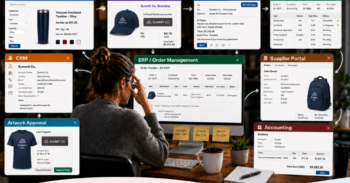
Tariffs, Rebates, and Surcharges, Oh My! A Promo Distributor’s Guide to Navigating Rising Costs Without Passing Them to Clients

Subscribe to the Growth Lab
Real strategies and insights for promo distributors who are serious about growing their business. Backed by over 20 years of industry experience.
Key Findings
- For promo distributors, a single pricing change doesn’t just affect that order, it creates a chain reaction of quote inaccuracies, client miscommunications, delayed orders, and internal chaos when systems aren’t connected.
- Missed supplier rebates are one of the most overlooked sources of margin loss. Most programs have quarterly or annual deadlines, minimum purchase requirements, and specific categories that are easy to miss when teams are stretched thin.
- Manual tasks, re-entering specs, checking pricing, and updating spreadsheets compound across hundreds of orders per year into a high and invisible cost.
- When pricing updates aren’t centralized, teams react after the damage is already done: inaccurate quotes go out, margins shrink, and clients get surprised by invoices that don’t match what they were told.
- Distributors who outperform during economic uncertainty aren’t necessarily bigger or better funded; they have more streamlined operations and better visibility into how their business is actually running.
- The goal isn’t to absorb every cost or pass everything along to clients. It’s to eliminate the internal losses first, so you have more flexibility to make that call on your own terms.
Table of Contents
- Are tariffs and surcharges really what’s hurting your margins, or is something else going on?
- Is it the price increase or the domino effect?
- Do you have to choose between protecting your margins and keeping your clients happy?
- Where is your promo business actually losing money?
- What’s manual work really costing you?
- Is your team reacting to pricing changes too late to protect your margins?
- Is efficiency a competitive advantage?
- What can you actually control when the market is unpredictable?
- How can you improve the way your business operates?
- Why is predictability more valuable than perfection for a promo distributor?
- Where is your business losing money?
- Frequently Asked Questions: How Promo Distributors Navigate Rising Costs
The short answer: Tariffs, surcharges, and supplier price increases get all the attention, but for most promo distributors, the bigger threat to margins was already there before any of that hit. Missed rebates, manual data-entry errors, and delayed responses to pricing changes quietly erode profitability across hundreds of orders every year, and none of it shows up as a single line item you can point to.
This article breaks down where the money is actually going, why passing costs along to clients doesn’t have to be the default, and what distributors who protect their margins during economic uncertainty do differently than the ones who don’t.
Are tariffs and surcharges really what's hurting your margins, or is something else going on?
Quick Answer
For most distributors, it’s both, but the part that’s harder to see is doing more damage. Tariffs and supplier price increases are real, but they land on top of inefficiencies that were already costing you money: missed rebates, manual errors, disconnected pricing information, and processes that force your team into reaction mode every time something changes. Fix the foundation first, and you have a lot more room to absorb the external hits.
For promotional products distributors, pricing changes aren’t a new concept, but it’s not just about cost; now you’re dealing with more than just a price increase. You’re also dealing with freight adjustments. Supplier surcharges. Rebate programs may change without warning. And when those things hit at the same time, the impact on your bottom line is real.
The instinct is to either absorb the cost or pass it along to the client. And you’re still expected to keep your clients happy, orders moving, and your teams productive.
But there’s another option that distributors overlook.
Fixing inefficient processes within your business that have been quietly costing you money long before tariffs or surcharges ever came into the picture.
Here’s where we break down where your losses are actually happening and some practical ways to protect your profitability without putting your client relationship at risk.
Is it the price increase or the domino effect?
Quick Answer
It’s what comes after. Price increases are a normal part of doing business and are usually manageable on their own. The real damage happens when a pricing change triggers a chain reaction: a rebate slips through the cracks, an update gets missed in one system but not another, and suddenly your client is calling about an invoice that doesn’t match their quote. That’s when the snowball starts and slowed operations, stressed teams, and strained client relationships follow.
Price increases happen, and usually that isn’t an issue for distributors. It’s part of doing business. But it’s not the price increase itself that causes the issues. It’s what happened because of the price increase.
You receive a quote from a supplier and then get notified that prices have changed. A rebate opportunity that you were counting on slips through the cracks because nobody had time to track it. Updates get manually entered into one of your systems, but get missed in the others. Now you have the client contacting you, asking why their invoice is more than the original quote. Now your team is thrown into chaos, attempting to put out fires instead of focusing on selling, finding the next client, or scaling the business.
After a while, those small problems balloon into large ones.
It’s not just the financial repercussions of that one issue that caused the snowball effect. It’s the snowball effect that it created: slowed operations, stressed teams, and the pressure on client relationships that you’ve painstakingly fostered over the years. For most distributors, that’s the part that really hits home.
The issue isn’t demand; it’s the way the business runs.
Do you have to choose between protecting your margins and keeping your clients happy?
Quick Answer
Not always, and that’s the point most distributors miss. The instinct when costs go up is to either absorb the hit or pass it along. But there’s a third option: finding and fixing the internal inefficiencies that were already shrinking your margins before the price increase ever arrived. Missed rebates, manual errors, and delayed pricing updates cost real money. Clean those up first, and you may not have to make that call at all.
When the supplier notifies you that there are pricing increases, you probably feel like you’re stuck between two less-than-optimal choices:
- Absorb the increase and take a hit to your profitability.
- Pass the price increase along to the client and risk damaging that relationship.
Neither choice is ideal, but neither must be the default either.
You may not realize there’s another option: improving visibility throughout your operations and cutting unnecessary losses that have been shrinking your margins long before cost increases.
Sometimes the hit to your margins isn’t cost increases. It’s that your business is losing money in other ways that are often overlooked.
Missed rebates. Manual errors and rework. Time-consuming processes. Delayed updates. Disconnected supplier information. Little things that add up throughout the order process, multiplied by hundreds of orders.
Those overlooked issues eat away at your margins before tariffs and surcharges have a chance.
Where is your promo business actually losing money?
Quick Answer
Usually, there are three places: one being supplier rebates, which don’t get tracked and claimed; manual tasks that eat time across every order every day; and delayed reactions to pricing changes because information is scattered across too many places. None of it feels like a big deal in isolation. A few minutes here, a missed rebate there. But multiplied across hundreds of orders, it adds up to a margin problem that has nothing to do with tariffs.
Though every distributor runs their business differently, there are some common areas where they lose profit and valuable time without noticing it until the numbers don’t quite add up at the end.
Missed Supplier Rebates
Supplier rebate programs exist to reward distributors for volume, loyalty, or meeting certain purchase requirements, but taking full advantage of them requires meticulous tracking. Many programs have quarterly or annual deadlines, minimum purchase requirements, or specific product categories that can be easy to miss if your teams are busy with orders, client updates, and ensuring that things run smoothly.
It’s not always the case that the rebates don’t exist; it’s that nobody has the extra bandwidth to fully take advantage of them. If there isn’t a system in place to monitor them, they’re put on the back burner and sometimes forgotten about.
So, what’s one missed supplier rebate? It’s not a big deal in the grand scheme of things. But they add up throughout the year.
What's manual work really costing you?
Quick Answer
More than most owners realize. Manual order entry, re-entering specs, double-checking supplier pricing, updating spreadsheets, hunting through emails for approvals and artwork. Each task takes a few minutes and feels manageable in isolation. But when every person on your team is doing those things every day across hundreds of orders, the time cost is enormous. And time isn’t the only risk. Manual data entry means manual errors, and errors in pricing, supplier terms, or order details cost even more time and money to fix.
A huge amount of profit loss is due to manual tasks. Not just one here or there. Manual tasks that are repeated throughout the day, every single day.
Manual order entry. Re-entering order details and specifications. Going back to the supplier to double-check pricing and inventory levels. Updating endless spreadsheets. Searching through emails and notes for approvals, artwork, and pricing details.
Each of those tasks takes a few minutes and may not seem like a big deal. What’s a few minutes, right? But if every person on your team is doing that daily, it’s taking a tremendous amount of time and, ultimately, costs you money.
And then you must consider the mistakes that can easily be made while manually entering data or writing things down. Especially if those things are pricing updates, supplier terms, and inventory issues.
Is your team reacting to pricing changes too late to protect your margins?
Quick Answer
If your pricing information lives in more than one place, almost certainly yes. When updates have to be manually entered across spreadsheets, emails, and disconnected systems, something always gets missed and the damage shows up later as an inaccurate quote, a client who got a different number than their invoice, or a margin that’s already been lost. The faster your team can see and respond to a pricing change across the entire operation, the better your chances of protecting profitability before the problem compounds.
When pricing updates aren’t in one central location, teams typically react to the problem after the damage is done.
This often leads to:
- Quote inaccuracies
- Reduced margins
- Miscommunication with clients
- Internal chaos
- Order delays
The faster your response to pricing changes, the better your chances of protecting your profitability without damaging client relationships.
Is efficiency a competitive advantage?
Quick Answer
It’s your biggest competitive advantage. Distributors who have streamlined operations and centralized information can respond to pricing changes faster, make smarter decisions about what to absorb versus pass along, and spend their time on clients and growth instead of putting out fires. The ones who struggle aren’t always the ones with the least money; they’re the ones running the most reactively.
When there’s turmoil in the economy, efficiency within your business is the biggest competitive advantage that you can have as a distributor.
Having efficient processes in place gives you time to focus on what’s most important: growing the business, finding new opportunities, and creating a more positive experience for your clients.
If you and your team are spending most of your time searching for information that’s scattered, correcting errors that shouldn’t exist, or manually doing things that should be automated, it’s hard to do anything else. You’ve become reactive.
That matters most when it comes to client relationships. Many distributors are trying not to pass along every additional cost directly to their clients. This decision isn’t because they have a lot of extra capital to spare, but because they know how hard they worked to earn those relationships in the first place. The more streamlined your business can be, the more flexibility you have to make that call.
Distributors who stick to their pricing and focus on consistent program-based work outperform their competition every single time. It’s not because they have more money or larger teams, but because they have more streamlined operations.
What can you actually control when the market is unpredictable?
Quick Answer
More than it feels like right now. Tariffs will keep changing. Supplier costs will keep fluctuating. But how your business responds to those changes is entirely within your control. Better visibility into supplier programs, less manual work, faster reactions to pricing updates, and consistent processes across your operation. None of that requires the market to cooperate. It just requires a decision to stop running reactively.
Tariffs will continue to change. Supplier costs will continue to fluctuate. Surcharges will come and go.
But you don’t have to run your business in reaction mode.
The promo distributors that have the most success during these periods are the ones that:
- Have better visibility into supplier programs.
- Reduce manual work when possible.
- Find and stop revenue leaks.
- Respond to pricing changes faster.
- Have consistent processes in place throughout their operation.
This isn’t because they had an exclusive look into the future, but because they created processes that helped them be proactive, rather than reactive. They have a clearer picture of how the business is actually running.
How can you improve the way your business operates?
Quick Answer
Small, targeted changes to how your business tracks rebates, handles pricing updates, and manages order data can have a significant impact over time. You’re not trying to build a perfect operation overnight. You’re trying to build one that’s more manageable, more profitable, and less reactive than it was.
Trying to keep costs down and keep things moving smoothly can feel overwhelming, especially when there’s so much that can’t be predicted.
But that uncertainty also opens the door for distributors who are willing to improve the way their business operates.
Even small changes can make huge positive impacts over time. Better visibility in your business can help you make smarter decisions. More efficient workflows reduce the overwhelm that your teams may feel. Better processes help safeguard your client relationships.
You’re not striving to be perfect.
You’re striving to create a promo business that’s more manageable, more profitable, and less reactive.
Why is predictability more valuable than perfection for a promo distributor?
Quick Answer
Because perfection isn’t achievable in a business with this many moving parts, but predictability is. Distributors who come out ahead during economic uncertainty aren’t running flawless operations. They’re running consistent ones. Better visibility, fewer manual errors, and processes that don’t fall apart when something changes externally. The goal isn’t a perfect business. It’s more manageable, more profitable, and less reactive than it was before.
Attempting to keep costs down while keeping operations running smoothly can feel overwhelming, especially when there are so many external factors that you cannot control. While other distributors are scrambling, there’s an opportunity for those who are willing to take a hard look at their operations to find the flaws and improve.
Small changes can have a huge impact over time. Better visibility across your business helps you make smarter decisions. More efficient processes take the pressure off your team and ultimately protect the client relationships that you’ve spent years building.
Distributors who come out on top during economic uncertainty aren’t always the ones with the most money. They’re the ones who have the best insight into their operations.
The goal isn’t to build the perfect promo business; it’s to create one that’s more manageable, more profitable, and less reactive.
Where is your business losing money?
Tariffs and surcharges get all the attention, but for most distributors, the bigger hit is already happening. Missed rebates, manual errors, delayed responses to pricing changes, and processes that quietly bleed margin on every single order. The problem is, when your data is scattered across five different systems, it’s nearly impossible to see where it’s all going.
The Promo Growth Gap Calculator gives you a clearer picture. Answer a few questions about your business and get a personalized breakdown of where the room to improve is hiding.
Frequently Asked Questions: How Promo Distributors Navigate Rising Costs
How can promo distributors protect their margins without raising prices for their clients?
The most effective first step is identifying inefficiencies within their business: Missed rebate opportunities, manual process errors and rework, and delayed responses to pricing changes, before deciding whether to pass along the price changes to the client or not. Most distributors find that by fixing their operations and cutting unnecessary costs, they can avoid passing the increase along to the client and stay competitive.
What are supplier rebate programs, and how do they work?
Supplier rebate programs reward distributors after a specific criterion is met, such as volume purchased, loyalty over time, total amount spent, growth rebates, tiered structured rebates, and special pricing agreements, to name a few. They vary by supplier but typically occur on either a quarterly or annual basis. They’re designed to reward growth and performance, ultimately protecting margins while distributors grow their business.
Why do pricing changes cause disruption for promo distributors?
Most of the upheaval comes from disconnected systems and inefficient manual processes, not necessarily the price changes. When pricing updates are entered in multiple places: spreadsheets, notes, etc., the chance for errors to occur is significantly increased. This leads to inaccurate quotes, client miscommunications, and delayed orders. Centralizing pricing information is one of the most impactful changes a distributor can make.