Sales Strategies for 2027: How Top Promo Distributors Are Planning Ahead
Subscribe to the Growth Lab
Key Findings
- Top promo distributors start planning next year’s sales strategy early, with most planning throughout the year.
- Knowing where the business stands is the starting point for creating a successful strategy and realistic goals.
- Syncore helps reps identify patterns in customer accounts so they know which accounts to grow and where to focus first.
- Reps stay motivated through consistent communication: monthly group meetings, individual check-ins, daily reinforcement, and a real sense of ownership over their accounts.
- A shorter list of focus accounts is more effective and more achievable for reps, and it gives them the freedom to customize their approach.
Table of Contents
- When do promo distributors start thinking about sales planning for next year?
- What should be at the top of the list when it comes to planning your sales strategy for next year?
- How do you keep sales reps motivated and on track?
- How do you direct reps to the accounts that matter the most?
- When should you start implementing your sales plan for next year?
What’s always on its way but never actually arrives?
Tomorrow.
Waiting to build out your sales strategy works the same way.
It’s easy to tell yourself there’s plenty of time to map out your plan. But time passes quickly, and suddenly you’re left scrambling to piece together something that will set your team up for success all year.
Top promo distributors have already started planning their sales strategy for the next year. Most plan throughout the year, and many have already put those plans into motion. Every promo distributorship is different, so each will have its own way of doing things.
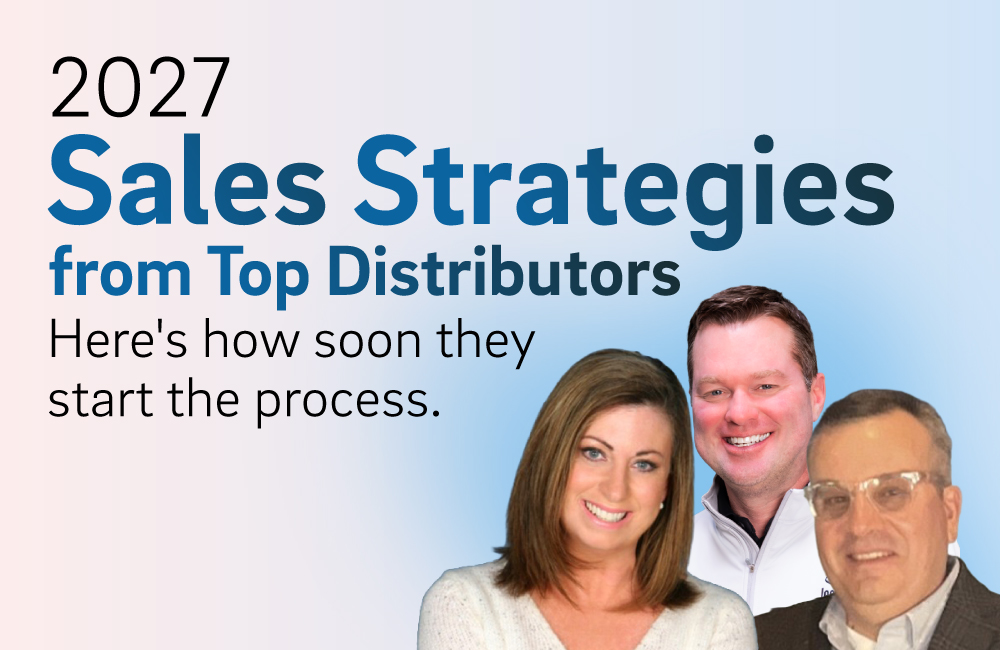
We recently sat down with three of Facilisgroup’s Distributor Partners to learn how they build their sales strategies for the upcoming year. Two tactics stood out: a top 10 “roadmap” that helps reps plan for their largest accounts, and 90-day focus accounts that receive a “full-court press.” We dive into both below, along with how these Partners set their goals and keep their reps motivated.
When do promo distributors start thinking about sales planning for next year?
Quick Answer
The Partners we spoke with all start early, from “right now” to year-round. None of them wait for the year-end rush to begin.
We asked each Partner that exact question. Here’s what they told us:
“We’re starting right now.” — Adrian Seaman, VP of Sales at The Specialty Company
“We think about it throughout the year.” — Ryan Glassford, Sales Director of Jeckil Promotions
“I rolled it out early. I’d say about the middle of September.” — Erin Harris, VP of Sales at McCabe Promotional Advertising, Inc.
Though their approaches differ slightly, what they have in common is that they all start early. They aren’t waiting for the year-end rush to begin planning for what’s next.
What should be at the top of the list when it comes to planning your sales strategy for next year?
Quick Answer
Start by understanding where your business stands, then set goals your leadership team agrees on. Historical account data turns guesswork into a data-based strategy.
Knowing you need to begin formulating a sales strategy for next year is one thing, but knowing where to start and what steps to take is another.
Understanding where your business stands, setting goals, and evaluating your progress throughout the year will not only set you up for success, but also help you shape the year ahead.
“We start by looking at creating a number that we want to get to. The leadership team gets together and does that,” said Seaman.
Glassford shared a similar take: “We see where the opportunities are, where the gaps are, where the problems are, and build a number that we can all agree upon from there.”
Harris took it a step further, describing a two-part approach that starts with giving her reps the tools to plan: “I’m rolling out tools that will help them plan for what their accounts might look like going forward, and how to build on that number in order to get it to the budget we want it to be as a leadership team,” said Harris. “The second part of that conversation is the conversation we’re having as a leadership group. Where do you want to be? What does the business look like? How is it trending throughout the year? And then looking at the bigger picture number and idea around our growth and revenue and going back to the team to say, ‘Okay, here’s the tool that we’ve built for you.’ It’s what we’re calling our roadmap.”
Determining a realistic number starts with knowing where you’re coming from. Pulling historical data, especially when accounts have changed hands, helps sales reps gain real insight into what they’re managing and what actions need to be taken. Syncore, the only 360° promo platform for distributors, lets you do that and more. Identifying patterns, such as which customers you’re doing more business with, what they may be ordering, and how frequently, helps your team see where the opportunities are. Instead of guessing and hoping something sticks, reps can start the new year knowing which accounts to grow, which require more attention, and where to focus first.
Knowing where you stand changes guesswork into a data-based strategy that your team can work toward.
How do you keep sales reps motivated and on track?
Quick Answer
Consistency and communication. Regular group and one-on-one meetings, daily reinforcement, and giving reps ownership of their accounts keep plans from becoming more forgotten documents.
Determining the numbers to hit and strategizing is just the beginning. The hard part is keeping reps motivated for the months ahead. Consistency and communication are key.
Glassford communicates the importance of goals and progress during regular meetings: “We’ll have monthly meetings with the overall group to talk about this. We’ll have bimonthly meetings individually with the reps. They’re about 30 minutes to an hour, to really dig into what’s going on with them and their client base. And then, we have typical conversations throughout the day and week. It’s constant reinforcement and pointing out opportunities and then saying, ‘Hey, I’m here to help,’ and then leading by example.”
Structure is only a part of it. Glassford says the other part is giving reps a reason to actually care: “Focus on execution just as much as revenue. Encouraging good habits that we keep talking about, but being consistent with those habits, getting everybody on board with that. Then, the most important part is to give the reps a sense of freedom to run their own business, too. And that really drives people when they’ve got skin in the game, and they’ve got a sense of ownership.”
The combination of meetings and daily reinforcement prevents the plan from becoming just another forgotten document, and giving reps ownership keeps them invested in it.
How do you direct reps to the accounts that matter the most?
Quick Answer
Provide a shorter, more focused list. Our Partners use a top-10 “roadmap” for the largest customers or 90-day focus accounts that get extra attention, while reps tailor their own approach to each customer.
Getting in front of customers is one of the most effective things a rep can do, but it’s only effective if the rep makes time for it. Every customer is different, just like every sales rep is different, so what works for one account may not work for the next. Our Partners create structure around their most important accounts, so reps know where to focus their time and can dig into what will be most effective for each customer.
For Harris, that structure is the roadmap she and her team have created. “It’s a living, breathing document. We are asking our team to do 10 at the most for their largest customers. It reviews last year’s numbers. It reviews different buying opportunities. What have they done seasonally or historically? Do we have a spot in their e-comm business? Do we have a program? A lot of topics that spark ideas to get them thinking about how to build moving forward. But we would certainly want them to curate that plan.”
Glassford narrows this down even further with 90-day focus accounts. “We recently started having 90-day focus accounts where we ask each rep to come to us. Three to five 90-day focus accounts where we put a full-court press on. We go heavy on specs. We run ZoomInfo lists and look at LinkedIn to find new contacts. We ask for referrals. It’s kind of turning up the volume from five to about eight or nine,” he said. “You don’t win them all, but it really helped us uncover new opportunities and ways we can help the client and grow our business. And then it makes the salespeople feel good too.”
Both approaches give sales reps a shorter, more achievable list instead of an overwhelming one, while also giving them the freedom to customize their approach for each customer.
When should you start implementing your sales plan for next year?
Quick Answer
Now. Not tomorrow. Starting early gives your team time to map out a successful strategy and access the tools they need to implement it.
Now. Not tomorrow.
Each Partner builds their plan differently based on what works best for their business and their customer base. They start early, establish goals, provide tools their reps need to execute, and continue to reinforce it all year. As Harris put it, “Start socializing the behaviors, the needs, and the mindset around what those goals are going to be next year, right now. Because you’re building the habit, you’re building the muscle, and you’re creating new neural pathways to make that happen.”
The strategy that you build today is the one that will set your team and your customers up for success tomorrow.
What's Preventing You From Scaling Your Promo Business? Find Out Now.
Landing the biggest clients or having the largest team isn’t always the answer. It’s planning ahead. Top promo distributors map out their sales strategies in advance instead of reacting later. When you’re stuck in reaction mode, it’s difficult to find time to plan, and nearly impossible to see where the gaps really are.
The Promo Growth Gap Calculator was built for exactly this. Answer a few questions and get a personalized breakdown of where your business has room to grow.

