The Demand for Eco-Friendly Products: How it’s Impacting Promo Distributors
Subscribe to the Growth Lab
Real strategies and insights for promo distributors who are serious about growing their business. Backed by over 20 years of industry experience.
Key Findings
- Seventy-four percent of consumers prefer receiving an eco-friendly promo product over one that isn’t, according to research commissioned by ASI.
- Promo products have a carbon footprint 8x smaller than digital advertising per memorized impression, according to a joint study commissioned by ASI, PPAI, and European promo partners, conducted by 51toCarbonZero.
- Many distributors are already selling sustainable products without calling them sustainable, the advantage is knowing how to talk about it.
- Demand for eco-friendly promo products varies by region, but it is gaining traction.
- Events and conferences are increasingly requiring or preferring sustainable, reusable, biodegradable, or zero-waste products.
Table of Contents
- A greener way of thinking.
- Why does sustainability matter in promo?
- How does product quality become your biggest competitive advantage?
- What are distributors seeing on the ground in terms of eco-friendly product demand?
- How do distributors source eco-friendly products?
- How do distributors talk about eco-friendly promo products with clients?
- How can promo distributors prepare for the growing demand for sustainable products?
- Why is the client experience worth more than a lower price tag?
- Is your promo business set up to meet the demand?
A greener way of thinking.
Quick Answer
Sustainability in promo isn’t just a conversation about the environment; it’s about meeting the demands of the consumers, understanding the products that you’re providing, and proactively having conversations to guide your clients in the right direction.
As a promo products distributor, you know that product quality is important, as is durability. But have you actually thought about what the products you’re offering are made of, whether they’re sustainable?
You may be thinking, “So what? What does it matter?”
Here’s why it matters: the distributors who succeed in this area aren’t always the ones that offer the biggest eco-friendly catalogs. They’re the ones who actually understand what they’re selling, they know how to discuss the value, and they can guide their clients through the process.
Why does sustainability matter in promo?
Quick Answer
Because your clients’ customers are taking note. Nearly 3 out of 4 consumers prefer eco-friendly promo products, and events and conferences are increasingly demanding them. Promo products are already highly carbon-efficient, making them easy to recommend to your clients.
74% of consumers stated they would prefer receiving an environmentally friendly promo product as opposed to one that isn’t, according to research commissioned by ASI. That’s nearly three out of four people.
That’s huge considering that promo products consistently rank among the top channels for brand recognition.
Something else that you may not know is that promo products are considered the more carbon-efficient option. According to the study commissioned by ASI, PPAI, & European promo partners, and conducted by 51toCarbonZero, promo has an eight times smaller carbon footprint than digital advertising when measured by memorized impressions (brand recall connected to a specific channel).
Promo products work because the entire process is built for efficiency. From sourcing materials and manufacturing to shipping and getting products into the hands of the end user. And unlike a lot of traditional advertising, a useful branded product sticks around, creates more brand exposure, and offers a lower-waste, higher-impact way to stay in front of customers.
So, here’s what we know:
- Nearly three-quarters of people prefer eco-friendly promo products.
- Every product is a direct representation of your client and their brand.
- Events and conferences are moving toward or strongly preferring sustainable, reusable, biodegradable, plantable, or zero-waste products.
It’s not just a passing trend. It’s a change in marketing, and distributors who get ahead of it will have a massive advantage.
What are distributors seeing on the ground in terms of eco-friendly product demand?
Quick Answer
It depends on the market. Demand is typically stronger in larger metro areas as opposed to more rural areas, but even distributors in the areas of less demand are seeing it trend in that direction. The distributors who are prepared aren’t scrambling to find answers when the question is brought up. They already know what they’re selling.
The data definitely makes for a compelling case. But what does the eco-friendly, sustainability shift actually look like in practice for a distributor in real conversations?
It depends on where you are.
One distributor we spoke with operates in a more rural market, where sustainable and reusable promo products aren’t being requested as heavily yet. They said a lot of it comes down to the client base and buying priorities in their region. The demand isn’t being dismissed, though, as they stated they do see it moving in that direction, just not as urgent as other larger metro areas.
What’s more interesting is how they’re prepared for it without making it a big deal.
When a client brought up sustainability, they didn’t have to scramble to find an option. They walked them through what they were already buying. A cotton T-shirt, for example, which is made from renewable resources, and they explained that the product has already met those standards. No upselling. No additional charges. No swapping to another option. Just a conversation that reframed what was already on the table, and the client was satisfied.
That’s a great example of a competitive advantage, and it’s definitely one worth paying attention to.
Why? Because many distributors are already selling sustainable products without calling them sustainable.
Even if an eco-friendly product isn’t a major request in your market today, chances are you’re already sourcing products made from recycled, reusable, or renewable materials. When a client asks about sustainability, you don’t want to start from scratch and risk losing an order or a client. You want to be able to say, “We’ve already got options for that,” or “You’re already getting it, no upgrade required.”
How do distributors source eco-friendly products?
Quick Answer
Start by looking at certifications and materials. Specifically, GOTS, GRS, Bluesign, FSC, and OEKO-TEX certified products, and know what the materials are: bamboo, organic cotton, rPET, and REPREVE. This is the proof that gives the eco-friendly, sustainable claims authority.
So, you’re ready to approach the eco-friendly products conversation with your clients. Here’s one thing to consider: before you start marketing your latest eco-friendly products, make sure that what you’re selling truly is eco-friendly.
A lot of products are being marketed as sustainable, but there’s nothing to back up those claims. And the worst part is when a client does their own research and finds out the product that you’ve sold them doesn’t meet those standards. Then you’ve caused major damage to the relationship that you’ve spent so much time and effort building.
Here’s how you can avoid this situation, protect yourself, and protect your client.
Look for specific materials and certifications.
Materials to look for:
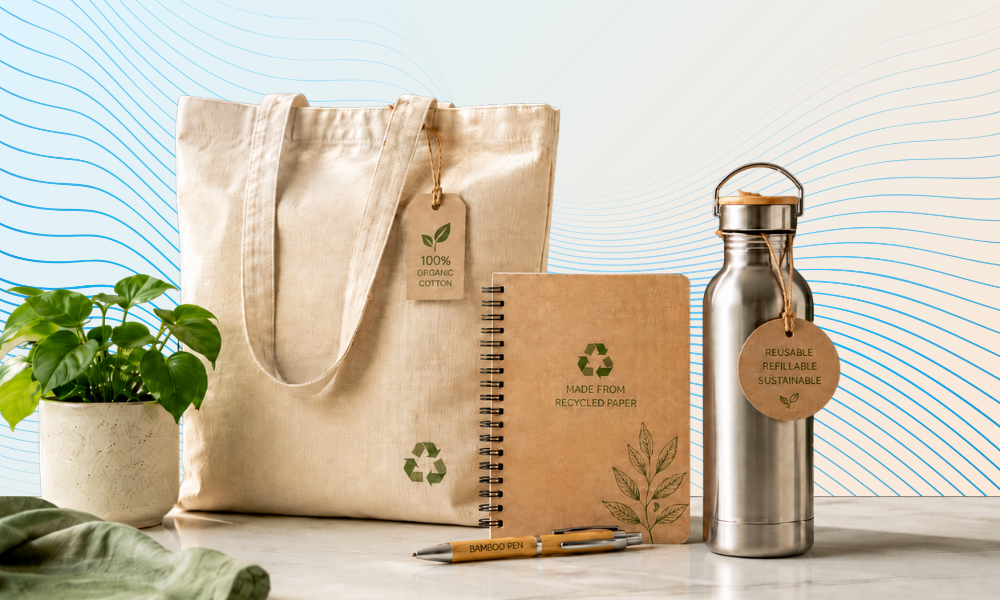
- Bamboo: A strong, highly renewable, and fast-growing grass that grows without fertilizers or pesticides, used in a variety of products.
- Hemp: One of the most durable materials grown without herbicides or pesticides, and it uses very little water or land to grow.
- Organic Cotton: Cotton grown without pesticides, chemicals, synthetic fertilizers, or genetically modified (GMO) seeds.
- Recycled Cotton: Cotton scraps or old shirts that have been shredded and made into yarn without dyeing the material or using water.
- REPREVE: A polyester that’s made 100% from recycled materials like plastic bottles.
- rPET: Recycled plastic broken down into flakes or pellets.
- TENCEL: A fiber created by dissolving wood pulp.
Certifications to look for:
GOTS (Global Organic Textile Standard): The product has met the strictest independent standards for organic and sustainable manufacturing. It’s guaranteed to be made with at least 70% certified organic fibers, non-toxic chemicals, and fair labor practices.
Recycled Content Certifications (GRS): Verifies that a product contains a specific amount of recycled material, prohibits the use of toxic or hazardous chemicals, ensures supply chain transparency, and requires fair labor practices and working conditions.
Bluesign: Verifies that the product has been manufactured in a way that is deemed safe for the environment, workers, and consumers.
FSC (Forest Stewardship Council): Mostly associated with paper products. Verifies that products have been sourced in an environmentally, socially, and economically friendly way.
OEKO-TEX: Verifies that the product has been tested for harmful chemicals and is safe to use.
How do distributors talk about eco-friendly promo products with clients?
Quick Answer
Lead with the client’s goal, not the product. Start with the solution, then add in the sustainability benefit. Know your product line well enough to confidently say, “You’re already getting it” when the question comes up. Always ask the purpose behind the request because the “why” changes your recommendation.
It doesn’t have to be complicated.
The distributors who benefit the most from the eco-friendly, sustainable product shift aren’t the ones who wait to be asked about them. They’re the ones who already know what they’re selling, how to talk about it, and they proactively bring it up.
Here’s how you can do that.
Start with the client’s goal.
Let’s be honest, most of your clients aren’t coming to you with a mission to ensure that the products and everything they represent are sustainable. They’re coming to you because they need products for an event, project, employee perk program, customer giveaway, or campaign.
That’s why it makes sense to start with the solution first and the sustainability offering second.
Instead of opening with, “This power bank is made from recycled materials,” try this instead: “This power bank meets all of your requirements, it’s within your budget, your logo can be engraved or imprinted on it, and it’s made from recycled materials.”
You’re leading with what helps the client achieve their goal and then reinforcing the recommendation with the sustainability benefit.
Start with the problem you’re solving, not the materials you’re selling, unless sustainability is one of the client’s top priorities.
Fully understand what you’re selling.
As the distributor we spoke with demonstrated, sometimes the most powerful move is knowing your product line well enough to point out, “You’re already getting it.” If eco-friendly or sustainable products come up in conversation, you don’t have to panic or start searching for other options. You show them the cotton T-shirt they’ve been ordering from you and explain it’s already made from recycled materials. Problem solved. Your client is happy.
That confidence comes from knowing what you’re selling before the question comes up. Not waiting until it does.
Ask what the requested products are for.
Some conferences and events now require exhibitors and sponsors to use recycled or sustainable products as giveaways. Some companies have made sustainability a major part of their operations and expect vendors they work with to align with those values.
When a client comes to you with those requirements, sustainability is a must-have.
If the products you recommend are handed out at an event with those specific guidelines or given to an organization that prioritizes sustainable practices, each product with your client’s brand must meet those expectations. If not, your client’s reputation will be at risk, and then you will be at risk of losing your client.
How can promo distributors prepare for the growing demand for sustainable products?
Quick Answer
Look at what you’re already offering. It’s likely that your product line already includes eco-friendly options. Probably more than you think. Learn the certifications, understand the materials associated with sustainable practices, and be ready for the conversation before it comes up. Clients choose you for your expertise. Be the expert.
The good news is that you’re probably closer than you think.
Many of the products being offered by suppliers are made from recycled, renewable, reusable materials. The difference is knowing which products meet the standards, understanding the certifications, and being prepared when a client asks the question.
Eventually, it will come up.
It may be a conference with sustainability requirements, a company with environmental initiatives, or a client who prefers eco-friendly options. The demand will continue to grow.
When that conversation comes up, the distributors who are prepared won’t be scrambling for answers. They’ll already have them.
That’s the real advantage.
Not completely overhauling what you sell but understanding it well enough to help your clients make informed decisions, meet and exceed expectations, and protect the brands they represent.
Your clients come to you for expert advice. Be the expert they’re looking for.
Is Your Promo Business Set Up to Meet the Demand?
Understanding the demand for eco-friendly products is one piece of the puzzle. But knowing how your business is positioned to meet that demand, and where your biggest growth opportunities actually are, requires a clear picture of your entire operation.
We built the Promo Growth Gap Calculator to help. Answer a few questions about your promo business and get a personalized breakdown of where the room to grow is hiding.