How Many Tools Does It Take a Distributor To Process a Promo Order?
Subscribe to the Growth Lab
Real strategies and insights for promo distributors who are serious about growing their business. Backed by over 20 years of industry experience.
Key Findings
- The average promo distributor touches five to seven separate systems to process a single order from initial client request to invoice.
- 69% of distributors report not using an ERP or shop management tool at all. Most are managing orders through spreadsheets, email, and manual processes.
- 70% of distributors use generic, non-industry-specific accounting solutions, meaning invoices are created in systems with no awareness of order details, margin expectations, or supplier costs.
- If each unnecessary system switch adds five minutes per order and your team processes 20 orders a day, that’s over 100 minutes of lost productivity daily, hundreds of hours per year spent on administrative friction.
- Facilisgroup partners have reported up to a 66% reduction in order processing time after moving to a unified platform. That’s not a marginal improvement, it’s a fundamental change in team capacity.
Table of Contents
- How many systems does it take?
- What actually happens across your systems when processing a single promo order?
- What’s the real cost, if it isn’t the software?
- What does a unified operating model look like?
- How do you know if your own workflow has a fragmentation problem?
- What’s the bottom line on disconnected tools and distributor growth?
- See What Your Tool Stack is Costing You
How many systems does it take?
Quick Answer
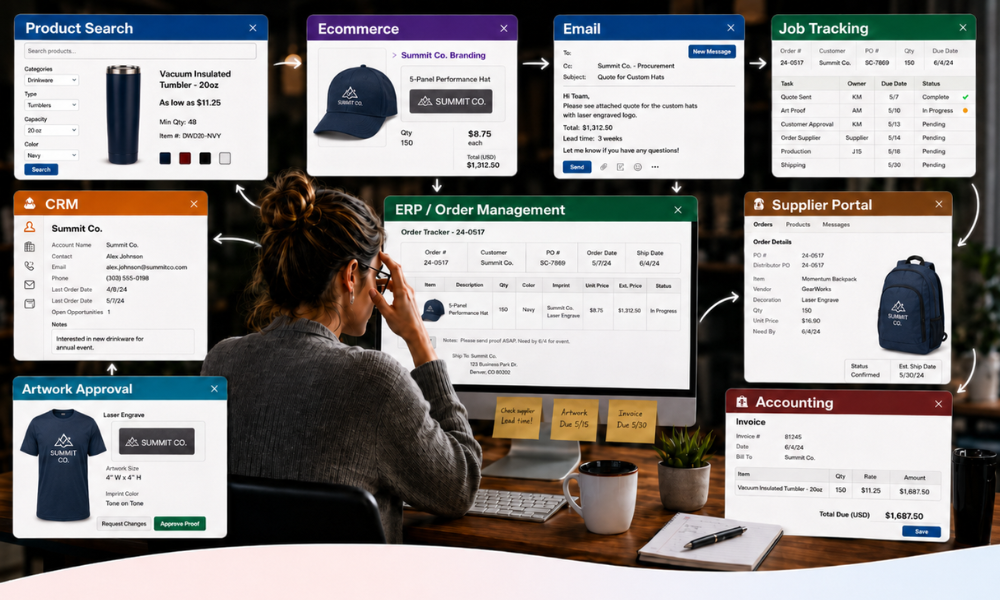
For most promotional product distributors, between five and seven. A product search tool, a quoting or presentation platform, email, a spreadsheet, a supplier portal, and an accounting system that has no awareness of anything that happened before it. None of them talk to each other. Every handoff between them is a place where data gets lost, time gets wasted, and errors creep in.
Think about the last order your team processed. Not a complicated one, just a standard branded drinkware order for a returning client. How many different systems did your team touch between the moment that the request came in and the moment the invoice went out?
If you’re like most promo product distributors, the answer is somewhere between five and seven. Product search tool. A presentation or quoting tool. E-mail. A spreadsheet program. An accounting software platform. Perhaps an e-commerce site. Or maybe a different CRM. Each serves a purpose, and none are talking to each other.
In an industry that just posted a record $27.7 billion in North American sales for 2025 (ASI Research), the operational infrastructure behind most of those transactions hasn’t kept pace with the revenue flowing through it. The gap between what distributors earn and what they keep often lives in the invisible friction of moving data between disconnected tools.
What actually happens across your systems when processing a single promo order?
Quick Answer
More than most distributors realize. A standard order such as a simple branded drinkware job for a returning client typically moves through product search, a quoting tool, email, a job management system, a supplier portal, a proofing workflow, and an accounting platform before the invoice goes out. Each of those transitions is a manual handoff where data has to be re-entered, double-checked, or reconciled by a person. That’s six or seven systems for one order.
Let’s walk through a typical order from start to finish and count the systems involved.
It starts with the client’s request. Usually, an email or phone call. Your sales rep searches for products using an industry product search tool. According to the 2022 PPAI Technology State of the Union, product search and presentations are the two most widely adopted tech solutions among distributors, with roughly 75% of respondents using industry-specific tools for both. So far, so good.
Next comes the presentation or quote. Your rep builds a proposal, often in a separate presentation tool, and sends it to the client. The client approves, and now the real operational handoff begins.
The order details get entered (often manually) into whatever system your CSR team uses to manage jobs. If that’s a spreadsheet or a shared drive, someone is retyping information that already exists somewhere else. A purchase order goes to the supplier. Artwork gets routed. Proof approvals come back through email. Shipping confirmations arrive in a separate thread.
Finally, once the order ships, someone in finance logs into your accounting system, most likely QuickBooks or a similar generic platform. The PPAI Technology State of the Union found that 70% of distributors use generic, non-industry-specific accounting solutions. That means the invoice is being created in a system that has no awareness of the order details, the margin expectations, or the supplier costs that preceded it.
By the time a single order is complete, your team has touched a product search tool, a presentation platform, email, a job management spreadsheet or system, a supplier portal, a proofing workflow, and an accounting platform. That’s six or seven systems for one order. And every handoff between them is a place where data gets lost, time gets wasted, or errors creep in.
What's the real cost, if it isn't the software?
Quick Answer
Context-switching. Every time a CSR moves from one system to another, they lose momentum, re-enter data that already exists somewhere else, and double-check information they can’t fully trust. That time doesn’t appear on any invoice, but across a team processing 20 orders a day, it adds up to hundreds of hours a year spent on friction instead of growth. And every manual re-entry is also a risk point for errors that cost even more time to fix.
The expense of running five to seven tools isn’t primarily the subscription fees. It’s the human cost of context-switching.
Every time a CSR switches from one system to another, they lose momentum. They retype or copy-paste information that should have flowed automatically. They double-check data because they can’t trust that what they entered in one tool matches what another tool shows. This is time that doesn’t appear on any invoice, but it compounds across every order, every day.
Consider what this means at scale. If each unnecessary system switch adds even five minutes per order, and your team processes 20 orders a day, that’s over 100 minutes of lost productivity daily. Over a year, that’s hundreds of hours spent on administrative friction instead of serving clients or supporting your sales reps.
And the cost extends beyond time. Manual data re-entry introduces errors, wrong quantities, missed decoration details, and incorrect shipping addresses. Each error requires rework, which costs more time and risks damaging your client’s relationship. In an environment where 76.1% of PPAI 100 distributors report that clients demand strong account management and faster fulfillment (PPAI Distributor Sales Insights, September 2025), the margin for operational error is razor-thin.
What does a unified operating model look like?
Quick Answer
One connected platform that handles the entire order lifecycle, from CRM and quoting through order management, supplier coordination, and invoicing, without requiring anyone to re-enter data between steps. When a rep creates a quote, the CSR doesn’t retype it to process the order. When the order ships, the billing information is already tied to the correct job, margin, and supplier cost. The handoffs between people still happen, the data friction doesn’t.
The alternative isn’t adding yet another tool to the stack. It’s replacing the patchwork with a single platform designed from the ground up for how promotional product distributors actually work.
This is the problem Facilisgroup’s Syncore software platform was built to solve. Syncore integrates the entire order lifecycle from CRM and sales to quoting, order management, supplier coordination, and finance into one connected workflow. When a sales rep creates a quote, the data doesn’t need to be re-entered for the CSR to process the order. When the order ships, the billing information is already tied to the correct job, margin, and supplier cost. The handoffs between people and departments still happen, but the data flows without friction.
The impact is measurable. Facilisgroup partners have reported up to a 66% reduction in order processing time after moving to Syncore. That’s not a marginal improvement; it’s a fundamental change in how much capacity your team has to grow the business without adding headcount.
And in a market where 35% of distributors delayed hiring or sales expansion due to economic uncertainty in early 2026, the ability to do more with your existing team isn’t a nice-to-have. It’s a competitive necessity.
How do you know if your own workflow has a fragmentation problem?
Quick Answer
Trace a recent order from client request to invoice and count the systems your team touched. Then ask three questions: How many times was order data manually re-entered? Can your finance team see job margin without leaving their accounting system? If a client calls right now asking for order status, how many systems does your rep need to check? If any of those answers makes you wince, you have a fragmentation problem.
Here’s a simple exercise. Pick a recent order and trace it from the initial client request through invoicing. For each step, write down which system or tool your team used. Then ask yourself three questions:
First: How many times was order data manually re-entered? Every re-entry is a risk point. If the same product details, quantities, or shipping information had to be typed into more than one system, you’re paying a time and accuracy tax on every order.
Second: Can your finance team see the margin on a job without leaving their accounting system? If the answer is no, if they have to cross-reference a spreadsheet or ask the CSR, your billing cycle is slower than it needs to be, and you may not catch margin erosion until it’s too late.
Third: If a client calls right now and asks for the status of their order, how many systems does your rep need to check? If the answer is more than one, you’re not just losing internal time; you’re delivering a slower client experience than your competitors who have invested in unified systems.
What's the bottom line on disconnected tools and distributor growth?
Quick Answer
The distributors who are growing fastest, taking on more clients, processing higher volumes, and protecting their margins have decided that processing one order shouldn’t require six or seven tools. The problem isn’t your people. It’s your toolset. And solving it starts with honestly counting the systems it takes to complete one order and asking whether there’s a better way.
The promotional products industry has grown to record levels. But for many distributors, the operational infrastructure underneath that growth is held together by manual handoffs, disconnected tools, and the sheer effort of people who make it work despite the system, not because of it.
Processing one order shouldn’t require six or seven tools. The distributors who are growing fastest, taking on more clients, processing higher volumes, and protecting their margins, are the ones who have decided it doesn’t have to.
If your team is spending more time moving data between systems than serving clients, the problem isn’t your people. It’s your toolset. And solving it starts with honestly counting the tools it takes to process one order and asking whether there’s a better way.
See What Your Tool Stack is Costing You
If you walked through the three-question exercise above, you already have a rough sense of where the friction lives in your workflow. The Growth Gap Calculator turns that gut check into actual dollars. Plug in a few details about your team size, monthly order volume, and how many systems your reps and CSRs touch in a typical job, and you’ll see what context-switching, manual re-entry, and delayed invoicing are quietly pulling out of your business each year.