Scaling Your Promo Products Business Doesn’t Have to Feel Overwhelming

Subscribe to the Growth Lab
Real strategies and insights for promo distributors who are serious about growing their business. Backed by over 20 years of industry experience.
Key Findings
- Promotional products distributors most commonly hit a growth ceiling in the $3M to $10M revenue range — the point where doing things the old way stops working and starts costing.
- Many owners at this stage are still operating as their business’s highest-achieving sales rep, chasing the next deal while nobody is building the systems that scale the operation.
- Disconnected tools, missed deadlines, constant rework, and an operation running on instinct are not signs that growth is hard — they’re symptoms of a business running its owner instead of the other way around.
- Separation of roles is one of the highest-leverage changes a growing distributor can make. When the right people are in the right roles, orders flow without the owner having to carry them through every step.
- Distributors who make the shift to proactive leadership report fewer errors, faster order processing, quicker invoicing cycles, and supplier rebates that were previously being left on the table.
- The hardest part of scaling isn’t adopting new tools — it’s accepting that the owner’s role has fundamentally changed. The ones who get through that resistance almost universally say the same thing: “I wish I had done this sooner.”
Table of Contents
- Is your promo business growing, or getting harder to run?
- Are you still running your business like its best sales rep?
- Is being busy moving your business forward?
- Is wearing too many hats slowing your promo business’s growth?
- What does scaling your business actually look like in practice?
- Where are the growth opportunities within your promo business?
Is your promo business growing, or getting harder to run?
Quick Answer
For most distributors in the $3M to $10M range, it’s both, and that’s the problem. Revenue is moving up, but the operation is running on instinct, disconnected tools, and an owner stretched across too many roles. “Keep doing what we’ve been doing” stops being a strategy at this stage. The plateau isn’t a demand problem. It’s a process and leadership problem.
“To resent efficiency is a mark of inefficiency.” – Henry Ford
Did that quote hit home a little?
You built your promotional products business from the ground up. You might’ve started as a sales rep who was really good at selling and eventually turned that into a business of your own. But at some point, as you continue to grow your business, usually somewhere in the $3M to $10M range, you begin to plateau. That’s when “keep doing what we’ve been doing” stops being a strategy and starts becoming a problem.
That’s when the cracks begin to show. Disconnected teams, missed deadlines, and an operation running on instinct instead of clear processes. After years of sticking to a certain way of doing things, inefficiencies have become impossible to ignore. Change is hard; nobody is going to argue that. But what we’ve seen consistently at Facilisgroup is that owners who persevere through that resistance and embrace the new tools, processes, and ways of thinking almost all say the same thing once they’re on the other side: “I wish I had done this sooner.”
Are you still running your business like its best sales rep?
Quick Answer
If you’re in the $3M to $10M range and still chasing down the next deal as the owner, probably yes, and it’s costing you. The skills that built your business aren’t the same ones that will scale it. When you’re focused on selling, nobody is focused on building the systems, managing the teams, or making the operational decisions that move the business forward. You can’t scale a business you’re too busy working in.
This may be hard to hear, but it needs to be said. The skills that you’ve used to build your promo distribution business aren’t the same skills that will scale it. In your previous life, as a sales rep, your job was to sell. You were good at it. Enough so that you built a successful company. But as your business grew, it also outgrew that role, and you may not have realized it. Many owners within the $3M-$10M range are still operating their business like their highest-achieving sales rep. Chasing down the next client instead of focusing on running the business itself.
That isn’t meant to be criticism. It’s one of the most common patterns that we see. I know that this may sound counterintuitive, almost like you’re stepping back from the business. The reality is that if you’re focused on chasing down the next deal, nobody is focused on building the systems and processes that need to be in place. Nobody is managing the teams or making the decisions that move the business forward. The hard truth is, you can’t scale a business if you’re too busy working in it instead of working on it.
The hardest shift for most promo distribution business owners isn’t adopting new tools or rethinking processes; it’s accepting that your role has changed. You now need to lead the business differently. You’re not stepping back from the business; you’re leaning into it.
Is being busy moving your business forward?
Quick Answer
Not if the busyness looks like manual data entry, constant rework, and putting out the same fires every week. Those aren’t the inevitable costs of growth, they’re symptoms of a business running on instinct instead of process. When owners shift from reactive selling to proactive leadership, the chaos doesn’t just become manageable. For most, it disappears. Orders go out on time. Communication syncs up. Teams execute instead of scrambling. And for the first time in a long time, there’s space to actually think.
Here’s what most people won’t tell you: when you fully embrace the leadership role, chaos becomes much more manageable and predictable. Disconnected tools and systems. Things falling through the cracks. Hours spent manually entering information. Double and triple checking for accuracy. The days, nights, and weekends without a break. None of that is “what growing a business looks like.” These are symptoms of a business running you, instead of the other way around.
When you shift your focus to leading and growing the business instead of selling and putting out fires, things change for everyone. Your teams are no longer grasping at straws and figuring things out on the fly; they’re executing with precision. The rework stops. Orders are going out on time. Communication is in sync. Details are no longer falling through the cracks. Everyone moves from reactive to proactive. Your clients notice. And for the first time in a long time, you have time to think, plan, and enjoy the business that you’ve poured your heart into.
Is wearing too many hats slowing your promo business's growth?
Quick Answer
More than you may think. When an owner is simultaneously acting as salesperson, account manager, operations manager, and decision-maker, none of those roles get the attention they need—and the business gets stuck in survival mode instead of scaling mode. Separating roles clearly isn’t about working less. It’s about making sure problems get solved, orders flow without the owner carrying them, and the business can function when you step away.
You’ve probably found yourself doing at least three to four different jobs at any given time, but maybe not doing them as well as they could be done. When you’re acting as the salesperson, account manager, operations manager, and key decision maker, you can only dedicate a portion of your time to each role, and it can be very overwhelming. When you’re focusing your time on everything else except for scaling your business, this puts your business into survival mode, not scaling mode.
Separation of roles isn’t just about making your business run better; it’s about giving you your life back. That doesn’t mean working less; it means working differently. When the right people are in the right roles, orders flow through the supply chain smoothly, without you having to carry them along the way. Problems are getting solved. The constant rework starts to disappear.
You’ve got solid processes in place, you’re no longer constantly reacting to problems every day, and you’re building something. You can think strategically about the next step to take and the relationships that need to be nurtured to continue the growth of the business, and for once, you can step away without fear of everything falling apart if you’re not there.
What does scaling a promo distribution business actually look like in practice?
Quick Answer
Fewer errors and less rework. Faster order processing. Invoices going out sooner and payments coming in quicker. Supplier rebates are captured automatically instead of being left on the table. But behind each of those outcomes is the same decision. An owner who stopped juggling every role and started leading the business differently. Real growth doesn’t look like chaos. It looks like an operation that runs without you carrying every order through it.
Based on what we’ve seen from promo distributors who have made the shift, here’s what scaling can look like:
- Fewer errors and less rework
- Faster order processing
- Invoices going out sooner and payments coming in quicker
- Supplier rebates captured automatically; money you were likely leaving on the table
These numbers are just a part of the story. Behind each one is an owner who made the decision to stop juggling and start scaling.
Real growth doesn’t look like chaos. It looks like a business that runs efficiently, with your team managing orders without needing you every step of the way. Fewer mistakes, faster turnaround times, and less stress keeping you up at night. Instead of spending every single day reacting, you can finally think ahead, strengthen relationships, and put your focus on where you want your business to go.
Scaling your business shouldn’t require sacrificing your time, your people, or your sanity to make it happen. If it feels that way now, it doesn’t mean that growth is too hard; it’s a sign that it’s time to do things differently.
Where are the growth opportunities within your promo business?
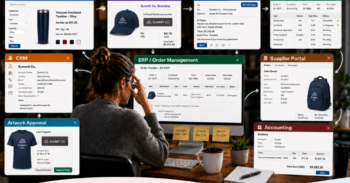
Disconnected tools, manual processes, and data spread across five different systems, it’s hard to see your biggest opportunities when you’re buried in the day-to-day.
We built the Promo Growth Gap Calculator to change that. Answer a few questions about your business and get a personalized breakdown of where the growth is hiding across margin, accounts receivable, average order value, and the operating metrics that top distributors track most closely.