5 Things Promo Distributors Should Be Ready for in 2027
Subscribe to the Growth Lab
Real strategies and insights for promo distributors who are serious about growing their business. Backed by over 20 years of industry experience.
Table of Contents
Ask a room of distributors what they’re changing in 2027, and you’ll hear the same answer. Sell more. Add accounts. Push harder.
Ask what they’re going to stop doing, and the room goes quiet.
I speak with many distributor owners, and patterns emerge before they show up in the research. The shops pulling ahead are simplifying things: Deeper supplier relationships. Fewer systems. Fewer steps between quote and invoice.
Promo spent a decade getting better at selling. The next belongs to distributors who get better at operating. That means subtraction. Here are five places I expect it.
Price stops working as a growth plan
Nearly nine in ten distributors raised prices in 2025, by an average of 11%. The industry grew 4.2%. Margins fell anyway.
PPAI’s end-buyer research says it won’t work twice. More than half of distributors report buyers getting more price-sensitive, and only 2% saw any easing. The next increase lands on someone who already absorbed the last one.
What to do about it: Keep growing but stop prioritizing headcount as the only growth lever. Growth is an investment, and the healthiest, most profitable growth comes when each new tier of revenue can be delivered without adding people. Instead, start looking at efficiency. Automate tasks where possible, use tools that reduce waste, and help your people work faster. Then measure what one order costs you to deliver.
AI moves from the art department to the back office
PPAI Research mapped where AI belongs in promo: artwork, marketing, operations, sales enablement, forecasting. It also noted which moves fastest: Artwork and marketing.
That is the lower-impact side. A faster mockup saves an hour. A quoting process that no longer needs someone to retype supplier pricing saves a role.
Across the Facilisgroup Partner network, distributors run roughly $2.54 million in sales per customer service rep. PPAI’s segment data implies closer to $1.5 million at comparable shops. That gap is not talent. It is the manual steps between a quote and an invoice.

What to do about it: Don’t jump at the first opportunity. Identify the bottlenecks and inefficiencies, starting with two tasks your team rekeys most. Find the best fit for each problem.
The buyer changes, and almost nobody is measuring it
We have studied Gen Z thoroughly as recipients of merch. As corporate buyers, we know almost nothing. No research on sales cycle length by buyer age, on whether they want a rep at all, or on what closes them. Distributors tell me newer buyers are harder to close, and nobody can explain why.
So, we started measuring what we could see. Our annual partner benchmark tracks retention and new business share across roughly 250 distributorships, which tells us how hard accounts are to keep and win. It does not tell us who is doing the buying. That is what we intend to measure next.
What to do about it: Don’t assume one approach works for every buyer. Get to know who is actually doing the buying at each account and how they prefer to work. Find common ground early and build trust from there. Relationships grow from understanding, and that understanding starts with knowing your clients.
Supplier lists get shorter
Distributors add fewer suppliers each year than they did three years ago, with industry research putting the average number around 20.
If you spread your spend across 40 suppliers, it doesn’t stand out to any of them: list pricing, no rebate tier worth chasing, and 40 relationships nobody keeps warm. Put the same dollars through 12, and you become an account somebody protects.
At Facilisgroup, we help distributors manage relationships through the Preferred Supplier Network, available only to members of the Facilisgroup Community. We vet every supplier for product quality, operational excellence, and cultural alignment, which changes the way they treat distributors. As John Byron, President of Prosperity Promotions, put it: “The vendors treat you differently when you’re with Facilisgroup. We’re not that little distributor in Kentucky; we’re a Facilisgroup member.”
Here’s what members get:
Unified buying power: $1.6B in network spend unlocks preferred pricing and better terms that individual distributors can’t get on their own.
Margin and rebate advantages: Exclusive discounts and meaningful rebates reward growth and protect margins.
Guided collaboration: Strategic guidance and joint planning turn supplier relationships into a competitive edge.
What to do about it: Pick a handful of your top suppliers whose products best fit your clients’ needs and be open and honest with them. Stronger relationships deliver better service, better visibility, and better discounts.
Rep ramp time becomes the growth constraint
PPAI’s State of Growth report puts 85% of revenue at distributors under $3 million in the hands of the top 10% of reps. The same report shows those distributors average one full-time rep. So the top 10% is the owner.
Hiring is how that changes, and it’s slow. New reps take months to get productive, and most learn by watching whoever has a free minute. In a busy shop, nobody does.
What to do about it: Be thoughtful about the first two weeks, 60 days, and 90 days. It’s important to invest in your people. Onboarding and sales training programs are something to consider. Amplifi, Facilisgroup’s exclusive Partner-focused sales development program, is designed specifically for reps in the promo industry and offers two different courses, each tailored to where sales reps are in their career. For someone new to the industry, the Electrifi course builds a strong foundational skill set, industry insights, and provides expert Syncore training, so they aren’t relying on whoever has a free minute. For an experienced rep with a solid client base, the ThreeSixty program helps them refine their approach, cut out the time-consuming processes, and focus on growing a more profitable book of business. Outside of that, check in at two weeks, six months, and nine months. Make sure you understand their challenges and work with them to help them become successful.
Three questions to ask yourself before January
- What does one order cost us to deliver, and when did we last measure it?
- Which of our people spend the day retyping something a system already knows?
- If the buyer at our three biggest accounts changed jobs, would we keep the account?
Each hides a subtraction: a step that shouldn’t exist, a supplier not earning its seat, a relationship living in one head.
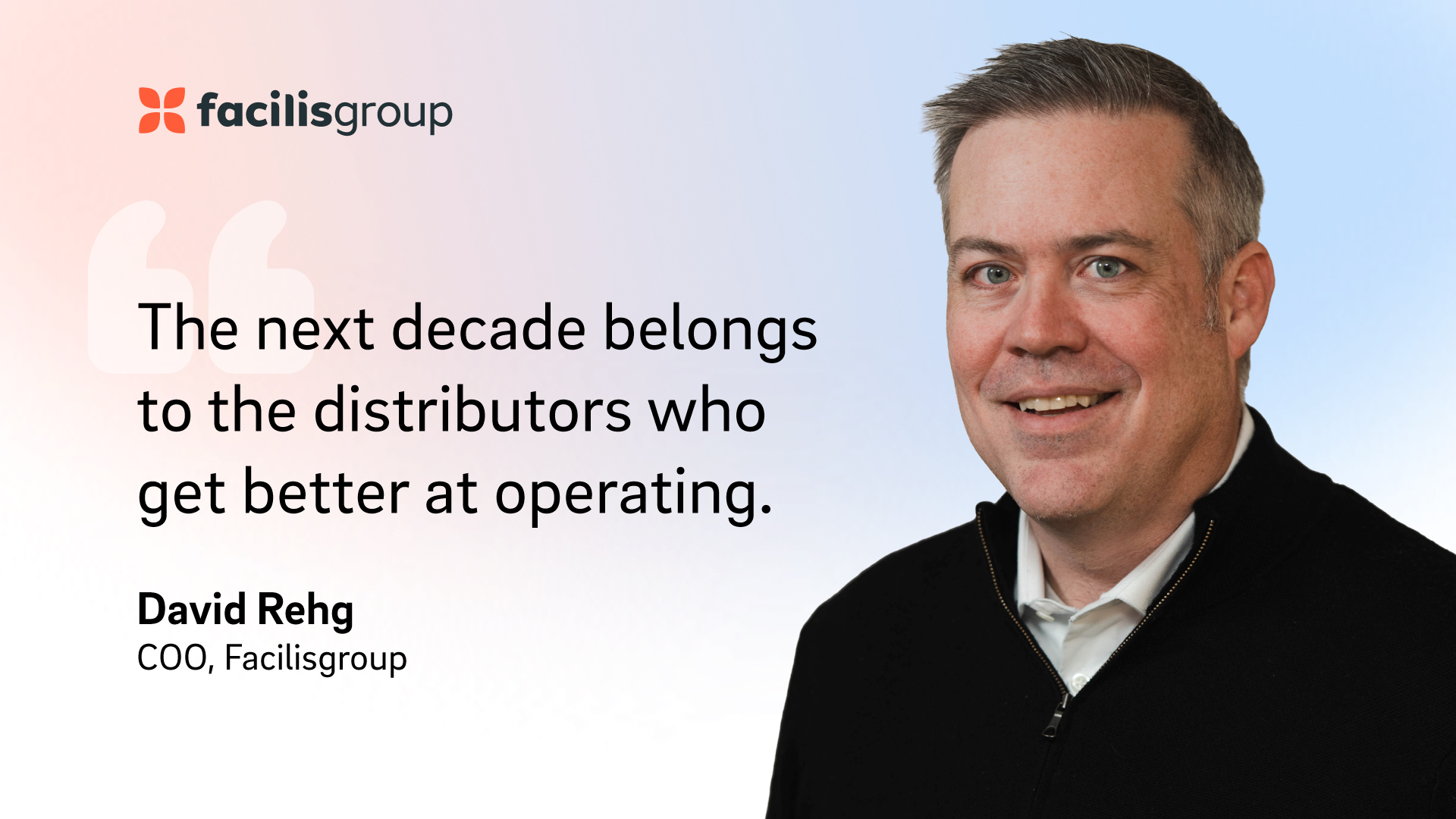
Promo has spent a decade getting better at selling. The next decade belongs to the distributors who get better at operating.
Take control of your future
Ready to escape the founder trap and scale to new heights? Discover promo’s only 360° platform and partnership for high-volume distributors at Facilisgroup.com.
Find Out Where Your Promo Business Is Losing Revenue
Manual data entry, inefficient processes, numerous disconnected tools, and rework, all factors that take time away from growing your promo business. The Promo Growth Gap Calculator breaks down the areas where your team is losing time and revenue. Check it out.
Frequently Asked Questions
If raising prices isn't working anymore, how can I protect my margins?
Focus on efficiency before considering adding to your headcount. Start by measuring what one order costs you to deliver and how many people and steps are involved in the process. Then automate where possible.
Where should I start with AI?
Look at the tasks that take the most manual effort. It could be the quoting process or the follow-up. Then decide how you handle each one: build your own tool, hire a third party to do it for you, or rely on your current software providers. Keep in mind that each choice has a trade-off: maintenance, a learning curve, and loss of control of what’s included and how it works.
How do I know which suppliers I should be working with?
Look at the suppliers you work with most and compare what they can offer you and your clients versus what the suppliers outside of that list offer. Weigh the quality and variety of the products, the rebates offered, and the price point. Keep the best fit for your business.

